
La Habra Previous Residents by Era
No single collection carries the complete story of La Habra previous residents. Each era has a different keeper, search key, and level of detail. The table separates ownership evidence from household evidence. Orange County recorded instruments can establish a transfer, but the index does not show every occupant. A directory can place a listed subscriber at an address, but it may omit unlisted people and its reverse arrangement must be checked. Census schedules, photographs, newspapers, permits, and probate files add context without turning any one source into a full resident list.
| Source | Years It Covers | Where Held | What It Shows |
|---|---|---|---|
| Orange County recorded instruments | County era from 1889; online index from January 4, 1982 forward | Clerk-Recorder and archives | Grantors, grantees, transfers, liens, and legal descriptions |
| Assessor and parcel maps | County era from 1889; exact series dates vary | Assessor, OC GIS, and OC Archives | APN, situs, valuation, parcel shape, and development context |
| La Habra permits | City era from 1925; online start not verified | City request route and EnerGov | Construction work, applicant, owner, or contractor when disclosable |
| Multi-city Orange County directories | 1926 and 1929 | NARA microfilm and partner access | Listed names, addresses, and occupation details as the entry supplies |
| GTE, Pacific Bell, and Whittier volumes | 1988-1994; later Whittier holdings 2003-2010 | LA County Library Californiana | Subscriber or address evidence; arrangement varies by volume |
| Federal population census | 1790-1950 released under the 72-year rule | NARA and genealogy databases | Household members, relationships, ages, and address context by year |
| Historic images and newspapers | Gallery clues from 1897; local newspaper by 1916 | City gallery, OCPL, and Historical Society | Residents, buildings, clubs, obituaries, and community events |
Start with a deed when the question is who held title. Start with a directory or census when the question is who was listed at the address. Use the same APN, legal description, street name, and date notes across the sources so that a strong name match does not outrun the land evidence.
La Habra Property Records Start at APN
A backward search becomes much safer when it starts with the parcel rather than a remembered surname. Use the Orange County secured-property search to establish the APN, situs address, available owner field, legal description, and assessment context. Then open the parcel in OC Land Records to compare the shape, tract, survey, annexation, and nearby geometry. Save the mailing address and situs address as separate fields. A tax mailing address can point to a trust, representative, or another location, and it does not prove who occupied the parcel.
The APN is the stable handoff into the recorder index. A postal street line may be abbreviated, renumbered, or absent from an older deed. A legal description identifies the land more precisely and can reveal whether a later parcel is the same tract, a split, or a new subdivision. Compare the map with the deed description before calling a name the owner of the target house.
Trace a La Habra Deed Chain
The Orange County Clerk-Recorder’s Grantor/Grantee Index is party based. It is not a street-by-street household directory, and the free result identifies a record without exposing the recorded image. The current owner or title party is the starting point, not the final answer. A deed chain moves from the present acquisition to the earlier seller, then from that seller’s earlier acquisition to the next seller.
The Orange County Clerk-Recorder services page identifies the office responsible for recorded land instruments and related county record services.
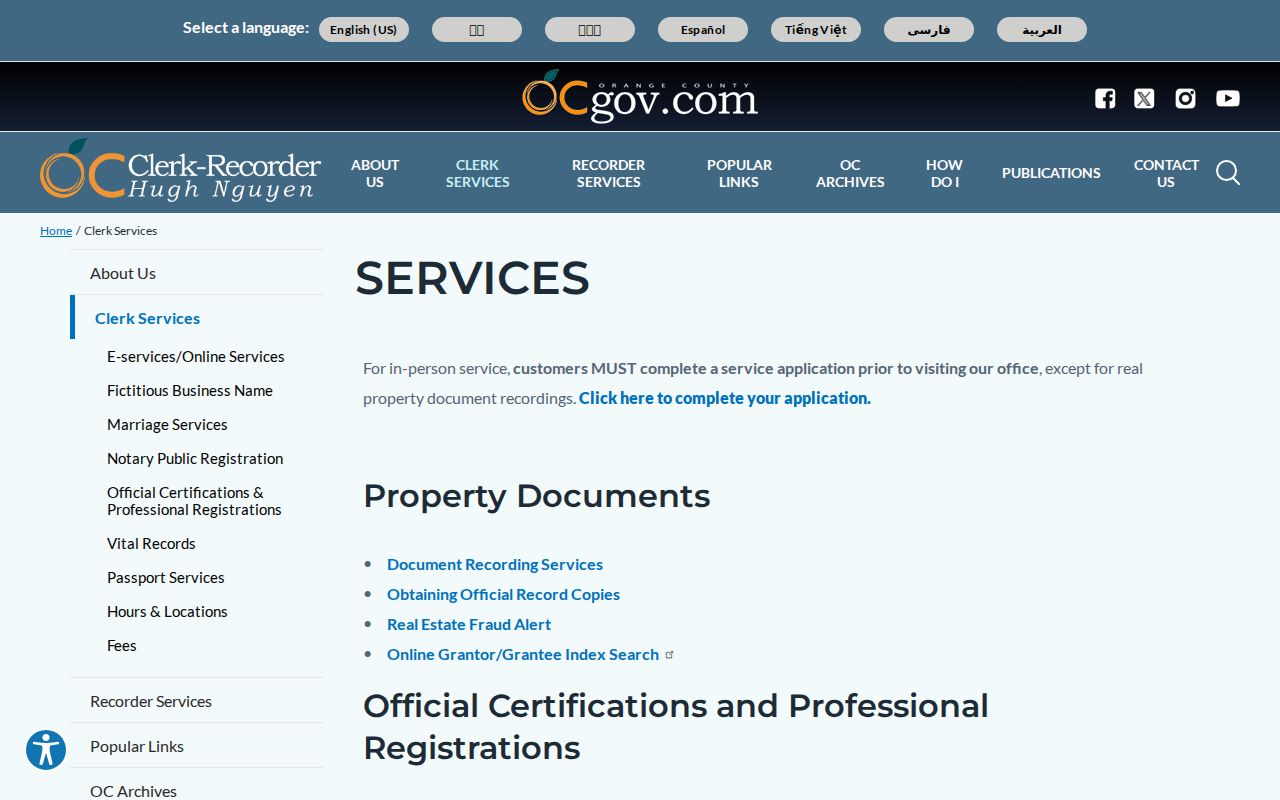
The office source keeps deed evidence separate from court probate files and from directory evidence about household members. Those record roles must be joined by parcel and date.
- Pull the current APN, situs, and legal description from the assessor and GIS records.
- Search the current owner’s exact indexed name in the recorder index, adding name variants and a recording-date range.
- Record the document type, recording date, instrument number, and book/page reference when shown.
- Open or order the instrument and confirm that its legal description matches the target parcel.
- Take the seller in the current deed as the earlier grantor, then search that party as a grantee in an earlier period.
- Repeat the seller-to-buyer move backward, running parallel searches for trusts, entities, spouses, and spelling variants.
- When the web index or image trail stops, preserve the old reference and move to index books, microfiche, the counter, or archives.
La Habra Deed Terms for Past Residents
Land-record terms are not household terms. These distinctions keep a title transfer from being treated as proof of residence.
- Grantor
- The party transferring an interest in the recorded instrument, often the seller or the party conveying title.
- Grantee
- The party receiving that interest, often the buyer or a trust, entity, or other named holder.
- Chain of title
- The linked sequence of recorded transfers that connects a current title interest to earlier parties and instruments.
- Legal description
- The formal land identity in a deed, such as a tract and lot reference. It can remain useful when a street name or number changes.
- APN
- The assessor’s parcel key. It helps match the tax record, map, and deed question to the same piece of land.
Read the index as an index. Results can list names, roles, dates, document types, and identifiers while leaving the full legal description and vesting language inside the instrument. View or order the document before naming previous residents.
La Habra’s 1982 Search Line
RecorderWorks states an online dividing line at January 4, 1982. From that point forward, the web index uses a year and instrument-number convention. Earlier records rely on book, page, and instrument references, index books, microfiche, office access, or archival series. The date is a search boundary, not the beginning of Orange County land history. The county’s recorded property material reaches back to the county era from 1889.
The official-record-copy instructions explain the difference between an index identifier and a copy request for a recorded instrument.
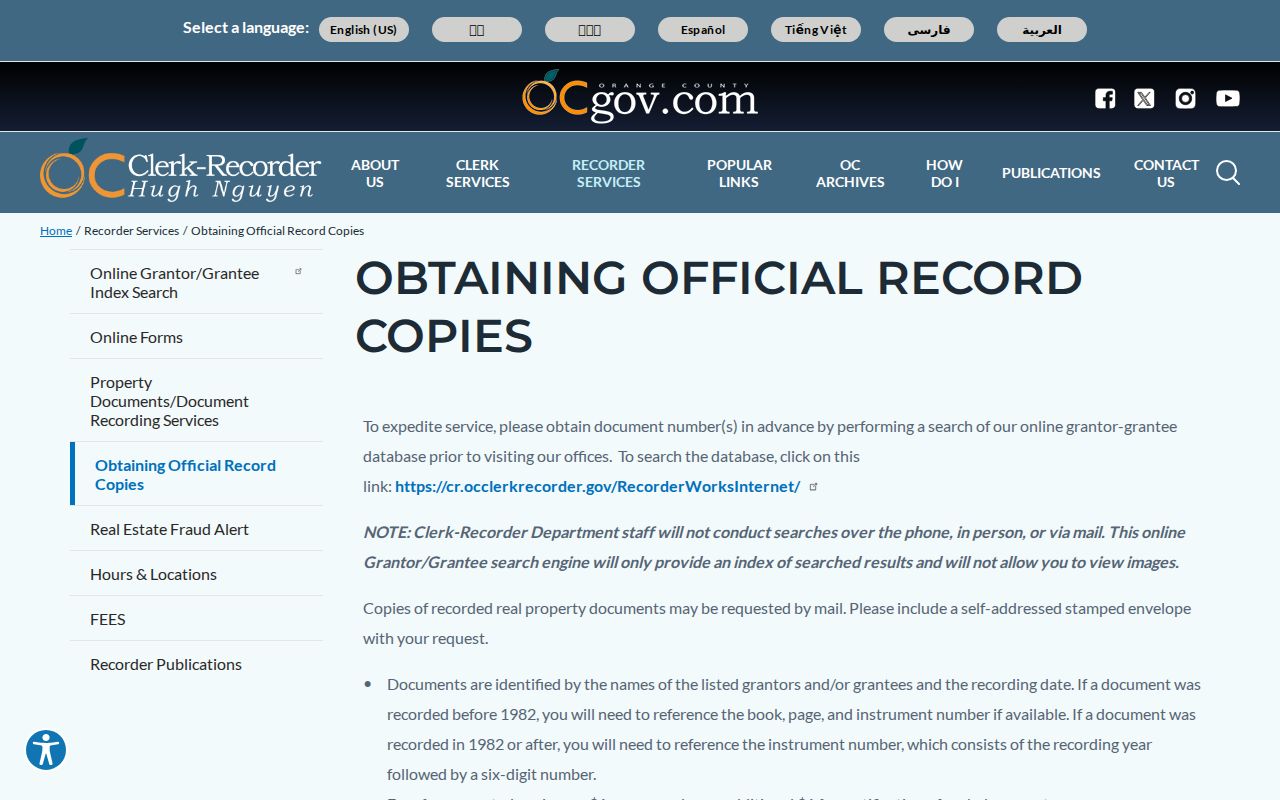
The copy route requires the document number or older reference, a written request, and the county’s stated payment and mailing steps. The documented copy charge is $1 per page plus $1 for certification of each document or map. Mail requests go to Orange County Clerk-Recorder, 601 N. Ross Street, Santa Ana, CA 92701, with questions at 714-834-2500. Confirm the current schedule before sending money.
Recorder staff direct patrons to search the index themselves. Bring the APN, name variants, date range, and book/page or instrument clues rather than asking the office to reconstruct the chain.
La Habra’s 1889-1953 Archive Story
Orange County preserved 640 original property-deed volumes dated 1889-1926 and 210 property-index volumes dated 1889-1953. The preservation account describes page-by-page deacidification, Mylar sleeving, and fireproof rebinding, followed by conservation and microfilm work. That history matters to La Habra previous residents because the modern web cutoff can make a record look absent when the older evidence has simply moved to a different access channel.
Use Orange County Archives to ask about series title, inclusive dates, index arrangement, retrieval rules, and appointment needs. The California State Archives research gateway is a separate state-level path for collections and should not be mistaken for the county recorder’s deed custodian.
The California State Archives gateway is a useful example of why archival research often begins with a collection description before a name search.
Before incorporation, a La Habra address is documented through county, land-grant, church, newspaper, federal, and community sources rather than city records.
Pair La Habra Directories and Census
Ownership is only one layer of previous residents. The directory and census workflow asks who was listed at an address and when. NARA’s directory table places La Habra inside multi-city Orange County volumes for 1926 and 1929. The LA County Library Californiana inventory adds GTE “Whittier and nearby cities,” Pacific Bell “Orange County North,” and later Whittier volumes. La Habra can hide inside a neighboring-city title.
Check the title page and abbreviation key before copying an entry. A volume may show a name, spouse notation, address, telephone, occupation, or owner marker, but arrangement varies. The research did not verify a specific La Habra reverse section in each run. Treat an address listing as evidence of a listing, not a complete household count.
- Write down the target address, known name, and year range, including old street wording.
- Find the closest directory year and copy the entry exactly, including initials, symbols, and abbreviations.
- Move one edition at a time and note whether a disappearance could reflect a missed canvass, move, death, service boundary, or publication gap.
- Pair 1940 and 1950 directory evidence with the released federal census, which is currently open through 1950 under the 72-year release rule.
- Use the directory-to-census match to test household relationships, then return to deeds and maps for ownership.
The La Habra city directory collections reference holds the year runs. Use them as one address trail, without assuming a full reverse listing.
La Habra Central Avenue Address Trap
La Habra Boulevard was historically Central Avenue. The official local source confirms the earlier name but not an exact rename year. Search both forms in directories, newspapers, maps, permits, and deed indexes. Keep the source’s spelling and mark the year gap as unresolved until a dated record bridges it.
Other continuity traps include Rancho or subdivision legal descriptions that do not resemble a postal line, postwar subdivision growth, parcel splits, annexation or city-limit changes, and a tax bill that displays only the first deed name even when multiple grantees hold title. Use the APN, tract, lot, and legal description to test continuity. A familiar street name alone is too weak for a century-long claim.
La Habra Records: Permits, Obituaries, Probate
Physical and family events can close gaps in a deed chain. La Habra permit and planning records may date construction, additions, demolition, or a change of use. They can identify an applicant, owner, architect, or contractor when disclosable, but a permit proves work, not residence. Use the city’s public-record request route with the address, APN, project number, date range, and format.
The Clerk-Recorder’s online-services index shows the kind of official request channel to check before assuming an older record is unavailable.
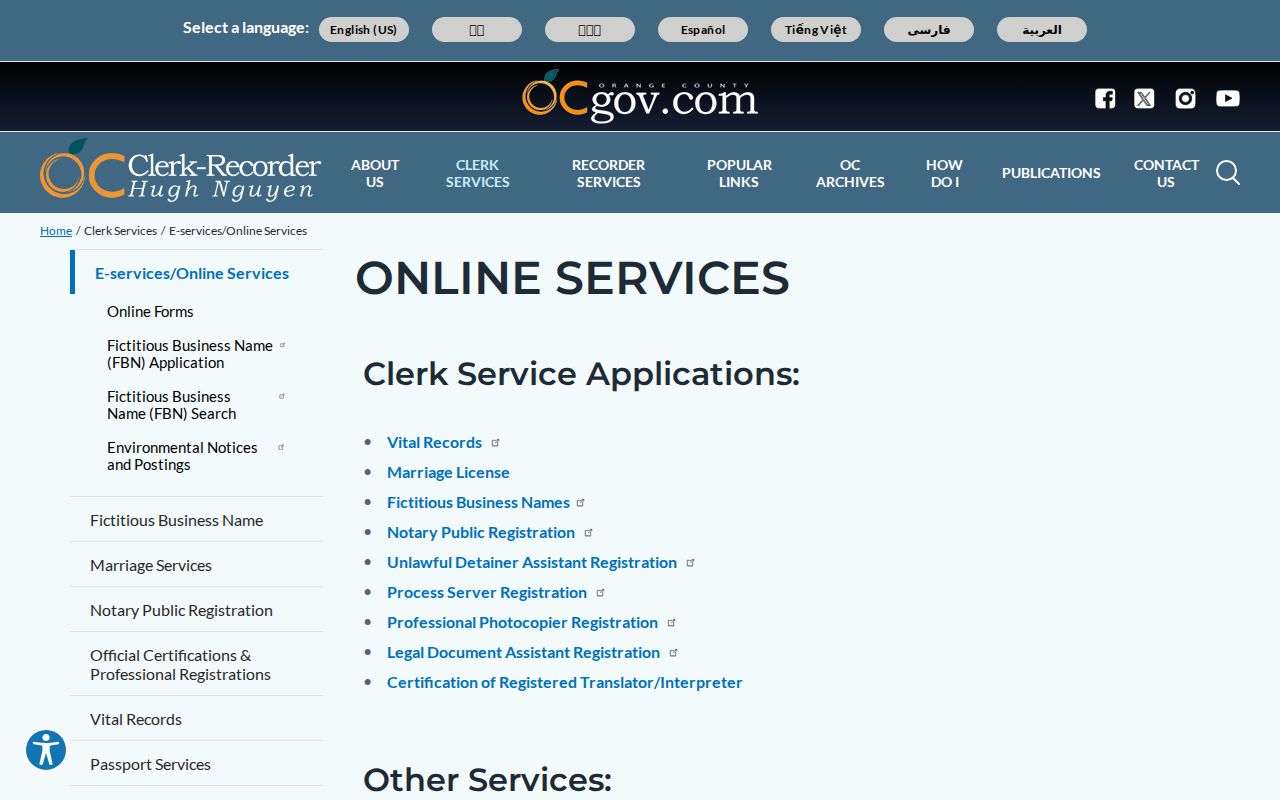
Obituaries and cemetery records can explain when a former resident died, moved from an address, or left a family connection. Probate petitions and notices can identify heirs, estates, or trusts that explain a deed transfer. The Orange County Superior Court holds probate files, not the Clerk-Recorder. Match the legal description, date, and case information rather than relying on a surname alone.
The California Public Records Act can request an identifiable existing file, but cannot create a resident list or replace special court, vital, voter, and protected-address rules.
Use La Habra Previous Residents Lawfully
Previous residents research is well suited to house history, genealogy, estate work, and personal curiosity. Keep source dates and record roles visible. Do not turn a deed party into a current occupant, a directory listing into a complete family, or a public address clue into an invitation for unwanted contact.
Lawful house history. Use La Habra previous-resident records for family history, property history, and other lawful personal research. Repeated harassment or threats are not protected by public-record access, and California Penal Code section 646.9 addresses stalking conduct that includes a credible threat and a course of conduct.
When records conflict, return to the custodian that holds the instrument, court file, city file, library collection, or archive finding aid. That chain of custody keeps the account of La Habra previous residents durable.